Luke 12:15 - 21
And he said unto them, Take heed, and beware of covetousness: for a man's life consisteth not in the abundance of the things which he possesseth.
The University of the Philippines Open University (UPOU) offers various undergraduate and graduate degree programs, as well as diploma courses and certificates. Here are some of the degrees and courses offered ¹:
Undergraduate Programs:
Bachelor of Arts in Multimedia Studies (BAMS): Focuses on digital media, communication, design, and multimedia production.
Massive Open Online Courses (MOOCs):
Business and Entrepreneurship: Understanding the Language of Business, Business Concepts, Ideation, and Business Plan
Other Courses:
Medical and Health Sciences: Medical Informatics for Medical Educators, Primary Healthcare-Oriented Practice for Specialists, Clinical Ethics series for Tertiary Hospital Care
UPOU offers flexible, fully online learning environments, making it suitable for working professionals, lifelong learners, and students who need to balance their education with other commitments ¹.
What are the requirements?
To apply to the University of the Philippines Open University (UPOU), you'll need to meet the following requirements:
General Requirements:
Application Fee: PHP 350 for Filipino citizens or USD 75 for non-Filipino citizens
For Freshmen:
High School/Senior High School Graduates: Scanned copies of Form 137 and Form 138 with date of graduation and school's dry seal
For Transfer Students:
Official Transcript of Records (OTR): Original copy indicating date cleared by the concerned UP units and a Permit to Transfer
For Graduate Programs:
Bachelor's Degree: Any field
Additional Requirements for Foreign Applicants:
Authenticated Scholastic Records: Duly authenticated by the Philippine Foreign Service Post located in the student applicant's country of origin or legal residence
As the gospel of Yeshua's message was spreading throughout the land, mostly documented in the book of Acts, three people groups are mentioned; the Jews, the Greeks and the Gentiles. Unfortunately due to misinterpretations and mistranslations of the text, there is a lot of misunderstanding over who these people are.
What Does Ethnos Mean in the Bible? (And Why “Gentile” Is Misleading)
The Original Meaning of Ethnos and Goy
The Greek word ethnos (Strong's #1484) literally means "nation." This word is used in the 2,000 year old Greek Septuagint to translate the Hebrew word goy (Strong's #1471), which also means "nation." A nation is any group of people living and working under one rule. Many different nations are mentioned in the Bible including; the Canaanites, Egyptians, Moabites, Arameans, and others. But more importantly even Israel is called a "nation."
And I will make of thee [Israel] a great nation (goy)... (Genesis 12:2, KJV)
... and of good report among all the nation (ethnos) of the Jews... (Acts 10:22, KJV)
Why Translating Ethnos as “Gentile” Is Problematic
Translating the Greek word ethnos in the New Testament as "gentile" is problematic. While the word "gentile" does mean "one belongs to a tribe or clan," it has come universally mean a non-Jew. But as we have seen, the words goy and ethnos do not mean a non-Jew, they mean "one who belongs to a tribe or clan."
Who are the Ethnon (nations) mentioned in the New Testament?
I am sure that most people are familiar with the "ten lost tribes" from the northern "nation" of Israel that was taken into captivity by the Assyrians in the eighth century B.C. It believed by most that these "ten lost tribes" are "lost," but this is not exactly true, at least not in the sense that most people assume.
New Testament evidence that the “lost” tribes weren’t missing:
Luke 2:36 – Anna is from the tribe of Asher (a “lost” tribe).
Matthew 15:24 – Yeshua says He was sent to the “lost sheep of Israel.”
Matthew 10:6 – Disciples sent to the lost sheep.
James 1:1 – James addresses the “twelve tribes scattered abroad.”
As we can see, the "lost" tribes are not "lost" in the sense of "missing," but in the sense of walking away from the teachings of Yahweh. When Paul preached to the "nations" in the Book of Acts, he was doing what Yeshua commanded, preaching to the "lost" tribes, the lost goy/ethnos of Israel.
Who Were the Hellenes in the New Testament?
The Maccabean Revolt and Jewish Resistance to Hellenism
The book of Maccabees, one of the books of the Apocrypha, tells the story of the Jewish Revolt about 150 years before the time of the New Testament. The Greeks, led by Antichus Epiphinus, conquered the land of Israel and forced the Jews to leave their national heritage and the Torah and begin following the Greek culture. Because of the Jews hatred for all things Hellenistic, including the culture and language, Judas Maccabee lead the revolt against Antichus Epiphinus destroying the Greeks and slaughtering those Jews that had adopted the Greek language and culture.
This revolt demonstrates the Jewish hatred of the hellistic culture and the incorrect assumption that the Jews freely adopted the Greek language during the time of the New Testament.
A Lasting Cultural Divide: Torah-Faithful vs. Hellenized Jews
This divide between the Jews who remained faithful to the Torah and the Jewish culture, and those who rejected the Torah and adopted the Greek culture continued to exist into the first century A.D. The Jews that adopted the Greek culture and language were called Hellenes (Oxford Greek Dictionary)
The Real Meaning of Hellenes in the New Testament
The word Hellenes is the word used in the New Testament, where it is usually translated as "Greek," but sometimes "Gentile," but does not refer to native "Greeks," but to Jews who have adopted the Greek culture and language.
Who Were the Jews in Contrast to the Hellenists?
Faithful to the Torah
The Jews, in contrast to the Hellenists, are those Jews that remained faithful to the Torah and rejected the Greek culture and language.
Who Were the Proselytes in the Bible? Understanding Foreigners Who Joined Israel
Proselytes in the New Testament
Only mentioned four times in the New Testament are the "proselytes" (Matthew 23:15, Acts 2:11, 6:5 and 13:43). The word proselytes is a transliteration of the Greek word proselutos, which means a "stranger" or "foreigner." These are non-Jews, what we would call today "gentiles," that have joined Israel and follow Yahweh and his teachings.
The Greek and Hebrew Connection
The Greek word proselutos is used in the Septuagint to translate the Hebrew word geyr, which also means a "stranger" or "foreigner," a non-Israelite. It was not uncommon for foreigners (geyrim) to join Israel, and many of them came out of Egypt with Israel.
A Mixed Multitude from Egypt
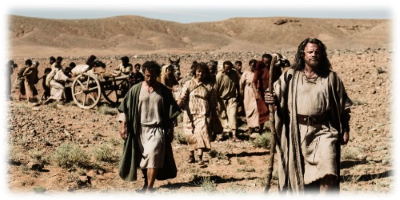
When Israel came out of Egypt, it was not just Israelites who came out, but a multitude of others. And the LORD gave the people favour in the sight of the Egyptians, so that they lent unto them such things as they required. And they spoiled the Egyptians. And the children of Israel journeyed from Rameses to Succoth, about six hundred thousand on foot that were men, beside children. And a mixed multitude went up also with them; and flocks, and herds, even very much cattle. (Exodus 12:36-38, KJV)
The Israelites journeyed from Rameses to Succoth. There were about six hundred thousand men on foot, besides women and children. Many other people went up with them. (Exodus 12:37,38)
Equal Standing Under the Law
These foreigners were to be treated the same as the Israelites.
The alien living with you must be treated as one of your native-born. Love him as yourself, for you were aliens in Egypt. I am the LORD your God. (Leviticus 19:34)
You are to have the same laws (mishpat) for the alien and the native-born. I am the LORD your God. (Leviticus 24:22)
Paul's Affirmation of Inclusion
Even Paul in the New Testament understood this and recognized that anyone could join Israel, just as they did in ancient times.
That at that time ye were without Christ, being aliens from the commonwealth of Israel, and strangers from the covenants of promise, having no hope, and without God in the world. (Ephesians 2:12, KJV)
Conclusion
We now have a clearer understanding of these four people groups;
The Jews: The observant Jews who reject the Greek culture and language.
The Hellenists: The Jews who adopted the Greek culture and language.
The Nations: The Jews from the ten lost tribes.
The Strangers: Non-Jews who join themselves with the Jews.
In another article I discussed the different people groups of the New Testament, the Jews, Greeks, Nations and Proselytes. In the Old Testament we have four different people groups; the natives, strangers, immigrants and foreigners.
Attempting to differentiate between these different people groups can be very difficult if you are using a translation as it is not uncommon for a translation to use the same English word for different groups. For instance, the King James Version uses the word “stranger” for זור (Z.W.R, a stranger, see Leviticus 2:10), גר (ger, an immigrant, see Exodus 2:22) and נכרי (nakhriy, a foreigner, see Deuteronomy 17:15). This is why it is imperative that one use a Hebrew dictionary, such as Strong’s, when doing a study of Biblical words."
Native
The natives (sometimes translated as “home-born”) are those who are born to one of the twelve tribes of Israel. The Hebrew word for a native is אזרח (ezrahh, Strong's #249). This word comes from the verbal root זרח (Z.R.Hh, Strong's #2224), which means to “come up” or “come out of.” So an ezrahh is one has “come out of” Israel.
All that are home-born shall do these things after this manner, in offering an offering made by fire, of a sweet savor unto Jehovah. (Numbers 15:13, ASV)
Stranger
The Hebrew verb זור (Z.W.R, Strong’s #2114) means “to be separated out.” The participle form of this verb means a “stranger,” one who is separated out. This word is frequently used in the Torah for someone who is not from one’s own tribe.
to be a memorial unto the children of Israel, to the end that no stranger, that is not of the seed of Aaron, come near to burn incense before Jehovah; that he be not as Korah, and as his company: as Jehovah spake unto him by Moses. (Numbers 16:40, ASV)
“If brothers dwell together, and one of them dies and has no son, the wife of the dead shall not be married outside the family to a stranger; her husband's brother shall go in to her, and take her as his wife, and perform the duty of a husband's brother to her. (Deuteronomy 25:5, RSV)
Immigrant
The Hebrew word for an immigrant (often translated as “stranger” or “sojourner”) is גר (ger, Strong's #1616) and is derived from the verb גור (G.W.R, Strong's #1481), which means to “dwell with” or “dwell among.” So an immigrant is one who is not a native born Israeli, but lives with the natives. According to the Torah, the immigrants are to live according to the same customs and laws as the natives.
One law shall be to him that is home-born, and unto the stranger (גר) that sojourneth (גור) among you. (Exodus 12:49, ASV)
And they are to be treated the same way as a native because the Israelites were once immigrants.
And a sojourner shalt thou not wrong, neither shalt thou oppress him: for ye were sojourners in the land of Egypt. (Exodus 22:21, ASV)
However, there are still some differences between a native and an immigrant, as is apparent in the following verse.
Ye shall not eat of anything that dieth of itself: thou mayest give it unto the sojourner that is within thy gates, that he may eat it; or thou mayest sell it unto a foreigner… (Deuteronomy 14:21, ASV)
Foreigner
A foreigner is one who was born in a foreign land, but unlike an immigrant, is not bound to the customs and laws of the native or immigrant.
Unto a foreigner thou mayest lend upon interest; but unto thy brother thou shalt not lend upon interest. (Deuteronomy 23:20, ASV)
There are two Hebrew words for a foreigner; נכרי (nakhriy, Strong’s #5237) and נכר (nekhar, Strong’s #5236). Both of these words are derived from the root נכר (N.K.R, Strong’s #5234) meaning “to be recognizable,” probably because a foreigner is easily recognizable due to their very different culture and lifestyle.
Best Estimates of the Number of Israelites in the Exodus
The question of how many Israelites left Egypt is one of the most discussed numerical issues in the Hebrew Bible. The text itself gives a clear figure, but scholars have long debated whether that figure should be taken literally.
1. The Biblical Figure (Traditional / Literal Reading)
Primary texts
Exodus 12:37: “about six hundred thousand men on foot, besides children.”
Numbers 1:46 (census at Sinai, Year 2): 603,550 men aged 20 and upward who were able to go to war (the Levites are excluded from this total).
Numbers 26:51 (second census, near the end of the wilderness period): 601,730 fighting men.
Total population estimate under the literal reading
Most traditional calculations multiply the 600,000+ fighting men by a factor of roughly 4 to account for women, children, and the elderly. This produces a total population of approximately 2 to 2.5 million people (some estimates reach 3 million when the “mixed multitude” of Exodus 12:38 is included).
Supporting references for the literal view
Apologetics Press population-growth modeling (using high fertility rates consistent with Exodus 1:7) shows that growth from ~70–80 people to ~1.8–2.4 million in 215 years is demographically possible under favorable conditions.
Conservative commentators (e.g., those associated with Answers in Genesis and similar sources) defend the plain reading of the Hebrew numbers as “thousands.”
2. The Main Scholarly Challenge
A population of 2+ million raises serious logistical and archaeological difficulties:
Sustaining that many people (plus livestock) with water and food in the Sinai wilderness for 40 years.
The near-total absence of archaeological traces of such a massive group in the Sinai or Negev.
The population of the entire highland region of Canaan in the Late Bronze Age / early Iron Age is estimated by archaeologists at only tens of thousands (Broshi & Finkelstein and related studies).
An army of 600,000 would have been many times larger than any known Egyptian or Canaanite force of the period.
These problems have led many scholars to question the literal interpretation of the numbers.
3. Alternative Interpretation: ’eleph (אלף) = “Clan / Troop / Military Unit”
The Hebrew word ’eleph (Strong’s 505) normally means “thousand,” but in some contexts it can mean “clan,” “family unit,” or “military contingent.”
Key scholarly proposals
Flinders Petrie (early 20th century) and later George E. Mendenhall suggested that the census figures originally referred to military units rather than thousands of individuals.
Colin J. Humphreys (“The Number of People in the Exodus from Egypt,” Vetus Testamentum 48/2, 1998, pp. 196–213) applied a mathematical analysis using the number of firstborn males (Numbers 3:43). He concluded that the fighting force was approximately 5,550 men, not 603,550.
→ Total population (men, women, and children): roughly 20,000.
Other variants of this approach yield totals in the range of 20,000–40,000 people (occasionally as high as ~70,000 in some models).
How the math works in the “clan” reading
In the tribal lists of Numbers 1, the figures are re-read as:
“X clans and Y hundred men.”
Summing the “hundreds” columns produces ~5,500 fighting men from ~600 clans/units. A later scribe is thought to have misunderstood the notation and treated every ’eleph as a full thousand, producing the large totals that now stand in the Masoretic Text.
4. Summary of the Best Current Estimates
View
Fighting Men
Total Population
Main Advocates / Sources
Literal / Traditional
~603,550
2–2.5 million (up to ~3 million)
Plain reading of MT; many conservative scholars; Apologetics Press growth models
Clan / Troop interpretation
~5,500–6,000
~20,000–40,000
Colin J. Humphreys (1998); Mendenhall; Petrie tradition; various modern critical scholars
Hyperbolic / Theological
Large symbolic number
Historical core much smaller
Many mainstream biblical scholars who see the numbers as idealized for theological emphasis
5. Balanced Assessment
Textually, the Masoretic Text clearly presents ~600,000 fighting men and therefore a multi-million-person nation.
Historically and archaeologically, a figure in the low tens of thousands is far more realistic and solves the major logistical and demographic problems.
The “’eleph = troop/clan” solution is the most widely discussed scholarly attempt to retain a historical Exodus while reducing the numbers to a plausible size. It is not universally accepted, however, because it requires assuming a misunderstanding or editorial alteration of the original figures.
Bottom line
The Bible as it stands gives a figure that implies approximately 2–2.5 million Israelites. The most carefully argued scholarly alternative that still treats the census data as reflecting real military units yields a total population of roughly 20,000–30,000. Both figures appear in serious literature; the choice between them depends largely on how one weighs the plain sense of the Hebrew text against the constraints of ancient demography, logistics, and archaeology.
Colin J. Humphreys, “The Number of People in the Exodus from Egypt: Decoding Mathematically the Very Large Numbers in Numbers I and XXVI,” Vetus Testamentum 48 (1998): 196–213.
George E. Mendenhall, “The Census Lists of Numbers 1 and 26,” Journal of Biblical Literature 77 (1958).
Broshi, M. & Finkelstein, I., population studies of Iron Age Palestine (Bulletin of the American Schools of Oriental Research).
Apologetics Press articles on Israelite population growth (defending the larger figure).
RSV Genesis 15:13 Then the LORD said to Abram, "Know of a surety that your descendants will be sojourners in a land that is not theirs, and will be slaves there, and they will be oppressed for four hundred years;"
From this passage it would appear that the nation of Israel served at least 400 years in captivity in Egypt. The lineage of Levi as recorded in Exodus 6 and 1 Chronicles 6 indicate only 3 generations between Levi and Moses (Levi-Kohath-Amram-Moses). If the slavery began shortly after Yaacov, his children and his grandchildren entered Egypt (the "70 in all" mentioned in Exodus 1:1-5), the maximum amount of time that this lineage could have existed in slavery in Egypt is approximately 350 years. (This is assuming the Kohath was at least an infant and part of the 70 entering Egypt and Amram was born to Kohath in the year of his death and Moses was born in the year of Amram's death plus the 80 years of Moses life before the exodus).
There are two possible ways of interpreting this passage. The first is that persons are missing in the lineage from Levi to Moses, but there is no indication of this anywhere in the text. The second possibility is to interpret this passage with the four hundred years being between Abraham and the exodus, which is how Rabbinic Judaism interprets this, including the Rabbi Shaul of the New Testament.
RSV Galatians 3:16,17 Now the promises were made to Abraham and to his offspring. It does not say, "And to offsprings," referring to many; but, referring to one, "And to your offspring," which is Christ. This is what I mean: the law, which came four hundred and thirty years afterward, does not annul a covenant previously ratified by God, so as to make the promise void.
In this passage Shaul is comparing the giving of the law with the promises given to Abraham, which he identifies as 430 years. With this interpretation, Genesis 15:13 is interpreted to mean that Abraham's seed will live in a strange land which, since Ishmael was born in a strange land (Canaan), would begin with the birth of Abraham's first seed. His decedents would also serve as slaves in a land not their own (Egypt).
Abram was 86 years old at the birth of Yishmael, his first seed to be born in a strange land. Abram was 100 years old at the birth of Yitsaac. There are 14 years between the births of Yishmael and Yitsaac. Yitsaac was 60 when he bore Esav and Yaacov. Assuming that each generation began at the father's age of 60, there are 300 years from the birth of Yitsaac and the birth of Moses. Moses lived 80 years before the exodus. Adding in the 14 years between the birth of Yishmael and Yitsaac, we have 396 years between the birth of Yishmael and the exodus. This is a very close approximation to the prophecy of Genesis 15:13.
This interpretation does have three problems. The first is that Shaul says 430 years, while the actual prophecy states 400 years. This is fairly easy to resolve by simply saying that one or both of these numbers are approximates. But, Shaul does take the number 430 from a passage in the Tenakh, which brings us to the second problem.
RSV Exodus 12:40,41 The time that the people of Israel dwelt in Egypt was four hundred and thirty years. And at the end of four hundred and thirty years, on that very day, all the hosts of the LORD went out from the land of Egypt.
This text indicates that Israel dwelt in Egypt for 430 years bringing us back to the problem of the lineage. This problem may easily be solved with the following observation. The text translated as "four hundred and thirty years" is "sheloshiym (thirty) shana (year) v'arbah (and four) me'ot (hundred) shanah (year)". It is possible that the original Hebrew was written as "sheloshiym (thirty) shana (year) v'me'ot (hundred) shanah (year)". This alternate reading would be translated as "one hundred and thirty years" placing the time of bondage shortly after Yaacov's entrance into the land of Egypt.
RSV Exodus 1:8 Now there arose a new king over Egypt, who did not know Joseph.
It has been assumed that this passage takes place after the death of Yoseph (Exodus 1:6) but many times the Hebrew text demonstrates that stories are not written chronologically. It is possible that this is the reign of the Hyskos who conquered Egypt that may have happened while Yoseph was still alive and they "did not know Yoseph".
A later scribe attempting to rectify Exodus 12:41 with Genesis 15:13 inserted the word arbah (four), hence, the translation of "four hundred and thirty years". This may also explain the reason for the two different numbers given for the "slavery" of the nation of Israel in Egypt.
The third problem is the number of male descendants of Yaacov who came out of Egypt.
RSV Exodus 12:37 And the people of Israel journeyed from Rameses to Succoth, about six hundred thousand men on foot, besides women and children.
According to this passage 600,000 men descended from Yaacov left Egypt. If each man is married with an average of 5 children, this brings the entire population of Israel to 6,000,000. This is not including the mixed multitude that came out with them (Exodus 12:38) or the flocks and herds that they also brought out. This large number of people creates a few problems. The first is the size of this "army" (Exodus 12:41 - hosts meaning army. Also Exodus 12:37 where the men are called gevoriym, or warriors) compared to the size of Pharaohs army of 600 chariots (Exodus 14:7), which brought fear to the Israelites. How could 600 chariots be considered a threat to 600,000 warriors of Israel? Equally puzzling is the fear the Israelites felt at entering the Promised Land where each city probably contained no more than 5,000 warriors compared to their 600,000.
Another problem is the simple logistics to supply feed, water and move such a large number. According to the Quartermaster General in the army, it would take 1,500 tons of food, 4,000 tons of wood as fuel and 11,000,000 gallons of water each day to supply the basic needs of this group. Another problem is the location of the Latrine.
RSV Deuteronomy 23:12,13 "You shall have a place outside the camp and you shall go out to it; and you shall have a stick with your weapons; and when you sit down outside, you shall dig a hole with it, and turn back and cover up your excrement.
A camp of this size would be approximately five miles by five miles square assuming only 1,000 square feet per family. One located in the center of the camp would require a hike of 2.5 miles to use the restroom.
Another problem is the estimated population of the nation of Israel compared to the estimated population of Egypt at this time. It is estimated that the whole population of Egypt at the time of the exodus was between 2 and 5 million. According to the above estimates of the population of Israel, the people of Israel would be greater than the entire population of Egypt.
Another problem is the large number of people is not possible with the number of generations available from Levi to the exodus. The average number of children born to the descendants of Yaacov is three to five. If we assume that the twelve children of Yaacov had 5 children, and the generation of Kohath, Amram and Moses each had 5 children, the maximum number of people (men, women and children), descended from Yaacov at the time of the exodus, would be approximately 7,500.
The Hebrew text of Exodus 12:41 states; "about six hundred thousand men on foot, besides women and children," but the Hebrew text can also be translate as "about six hundred chiefs (eleph) on foot are the warriors apart from the children" (The Hebrew word eleph can mean "thousand" or "chief," compare Strong's #s 441, 504 and 505). We now have a group of warriors that would find the 600 chariots of Pharaoh a formidable army. If we also assume that each chief (head of the family) included a wife and 5 children we have about 6,000 people, which correlate with previous calculation of possible descendants from Levi to the exodus.
Translating the word eleph as "chiefs" will also work for the census records found in the book of Numbers.
RSV Numbers 1:21 the number of the tribe of Reuben was forty-six thousand five hundred.
The Hebrew of this passage could also be translated as; "The number for the tribe of Rueben is 46 chiefs and 500". With this alternate translation we have 46 chiefs and 500 family members. When we apply this method to the remainder of the tribes we come to a total number of 598 chiefs and 5,550 others.
In summary, it would appear that the slavery of the Israelites in Egypt lasted about 130 years and approximately 6,000 individuals traveled from Egypt to Mt. Sinai.
One reader posed an important question concerning this article.
The English translations typically say, "..and took six hundred chosen chariots and all the other chariots of Egypt with officers over all of them." They also mention, "The Egyptians pursued them, all Pharaoh's horses and chariots and his horsemen and his army..." Doesn't this indicate there were not just 600 chariots in Exodus 14:6-9?
First let me say that I do agree that there was more to the Pharaoh’s army than just 600 chariots. His army also would have included his horse and foot soldiers. But, I do contend that there were only 600 chariots. Let me explain.
Hebrew authors will frequently parallelisms, which are stating one thing in two or more different ways. For instance, in Psalm 119:105 we read, "Thy word is a lamp unto my feet, and a light unto my path." There is not a lamp and a light, but only one "light." The phrase "lamp unto my feet" is a parallel with "light unto my path." While this form of Hebrew poetry is commonly found in the book of Psalms, it does occur throughout the Bible. But if one were not familiar with this style of poetry, it will easily be overlooked, such as in Exodus 14:7. Here is a literal translation of this verse.
and he took six hundred chosen chariots and all the chariots of Egypt, and captains over all of them.
When we read this from an English perspective, we assume that this speaking about "six hundred chariots" and "all the other chariots" (there is no "other" in the Hebrew text). But when this is read from a Biblical Hebrew perspective, the "six hundred chariots" are "all the chariots" of Egypt.
The early Hebrew (Semitic) alphabet was used by many Semitic peoples of the ancient Near East, including the Canaanites, Moabites, Arameans, Phoenicians, Amonites and the Hebrews. This alphabet existed between the 20th and 12th centuries B.C. However, note that the 20th century date is based on the oldest inscriptions found thus far and it is possible that future discoveries may push the date of the Semitic alphabet back even farther into history. To date, the Wadi El-Hhol inscriptions found in southern Egypt are the oldest Semitic inscriptions found and date to between the 19th and 20th centuries B.C. The Sinaitic inscriptions from the Sinai Peninsula date to about the 15th century B.C.
The Wadi El-Hhol inscription
Ancient inscription from Serabit El-Khadim
Middle Hebrew
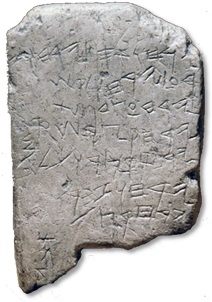
About the 12th Century B.C. the middle Semitic alphabet evolved out of the ancient Semitic alphabet. Like the more ancient alphabet, this middle alphabet was used by many ancient peoples of the Near East including the Hebrews. The Gezer calendar, the Ketef Hinnom Amulets and the Lachish inscription date to this time period.
The Gezer Calendar
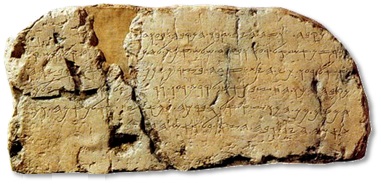
The Siloam Inscription
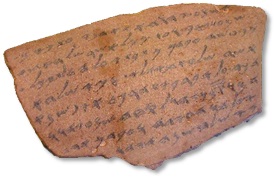
Lachish Ostracon
Late Hebrew
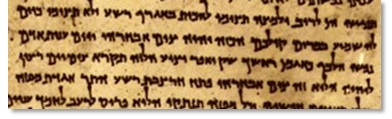
The late Semitic alphabet, which is the square Aramaic script, was in use between 4th century BC and into the early part of the modern era. The majority of the scrolls from the Dead Sea Caves is written in the late Semitic script and date to between the 2nd and 1st centuries B.C.
A portion of the Great Isaiah Scroll from the Dead Sea Caves
Modern Hebrew
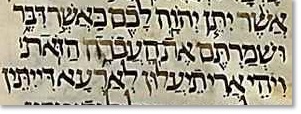
Derived out of the later Hebrew alphabet is the Modern Hebrew alphabet, which began around the 11th Century A.D. The Masoretic Hebrew texts of the Bible, written in the 11th Century, used this script and have changed very little to the present day.
And Moses wrote down all the words of the LORD. - Exodus 24:4 (ESV)
Remarkable new evidence discovered by Dr. Douglas Petrovich may change how the world understands the origins of the alphabet and who first wrote the Bible. As to be expected, his controversial proposals have ignited contentious debate.
In this first of a three-part series, the background and importance of this issue will be explored before some of the specifics of the new finds and the pushback from other scholars is covered in part two.
A common teaching in schools for many decades has been that the Phoenicians developed the world's first alphabet around 1050 BC. This alphabet was believed to have then spread to the Hebrews and other cultures in the Canaan area over the next centuries, eventually being picked up by the Greeks and Romans and passed down to the modern alphabets of today. However, many may have missed the implications of this view for the traditional understanding that Moses wrote the first books of the Bible.
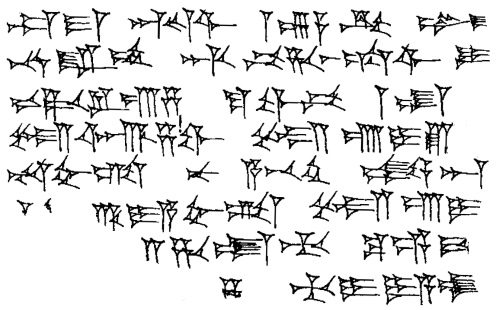
While writing had long been in use by the Egyptians and the people of Mesopotamia, they used complicated writing systems (hieroglyphics and cuneiform) that were limited because they employed nearly a thousand symbols with many more variants representing not just sounds, but also syllables and whole words. The messages they conferred were fairly simple, while the Bible uses complex forms of language. The genius of the first alphabet was to boil everything down to about two-dozen letters that originally represented the sounds of consonants only. From these few letters, every word of a language can be easily represented.
An example of cuneiform wedge shaped script that had hundreds of different symbols, some with 30 or more variants (from wikimedia commons)
For a work as sophisticated as the Bible, you need the flexibility of an alphabet. If the alphabet was not invented until around 1050 BC, then Moses could not have written the opening five books of the Bible four centuries earlier.
Now, new evidence that may change everything has been announced by Dr. Douglas Petrovich, an archaeologist, epigrapher and professor of ancient Egyptian studies at Wilfrid Laurier University in Waterloo, Canada. Epigraphy is the study of inscriptions - making classifications and looking for the slightest distinctives between writing systems while defining their meanings and the cultural contexts in which they were written. After many years of careful study, Petrovich believes he has gathered sufficient evidence to establish the claim that not only was the alphabet in use centuries earlier than some believe, it was in the form of early Hebrew, something that almost no one has previously accepted.
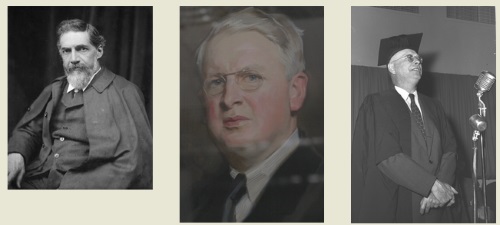
Three Giants in the fields of Egyptology, linguistics and archaeology. Sir Flinders Petrie 1853-1942 (from wikimedia commons), Sir Alan Gardiner 1879-1963 (copyright Thinking Man films), and William Foxwell Albright 1891-1971 (from wikimedia commons)
The standard presentation of Phoenician being the first alphabet is curious, since scholars have long known of much older alphabetic inscriptions. In 1904-1905 Sir Flinders Petrie, the father of Egyptian archaeology, and his wife Hilda discovered several rudimentary alphabetic inscriptions in the copper and turquoise mines that were controlled by the ancient Egyptians on the Sinai Peninsula. Sir Alan Gardiner, the premier linguist of his day, deciphered some of the writings and proclaimed that they were a form of primitive alphabet and that they used a Semitic language. The script became known as "Proto-Sinaitic" and was dated to the late Middle Bronze Age in the 1600s or early 1500s BC. W. F. Albright, the American known as the father of biblical archaeology, popularized the idea that these were Semitic writings and many took up the idea that Israelite slaves were responsible for these inscriptions. Hebrew, as the world's oldest alphabet, was first claimed in the 1920's by German scholar Hubert Grimme. "Although Grimme identified some of the Egyptian inscriptions as Hebrew, he was unable to identify all of the alphabet correctly," explained Roni Segal, academic adviser for The Israel Institute of Biblical Studies, an online language academy specializing in Biblical Hebrew, who spoke to Breaking Israel News.
As modern skepticism about the biblical account of the Exodus period took hold late in the 20th century, scholars have generally retreated from the idea that the Proto-Sinaitic inscriptions were the product of Israelite mine workers. Additionally, the discovery of many other alphabetic inscriptions in the Canaan area dated to the period from 1200-1050 BC prompted the need for a new category. These, and a few earlier fragments from that area that were all similar to the Proto-Sinaitic constructions, were labeled as "Proto-Canaanite."
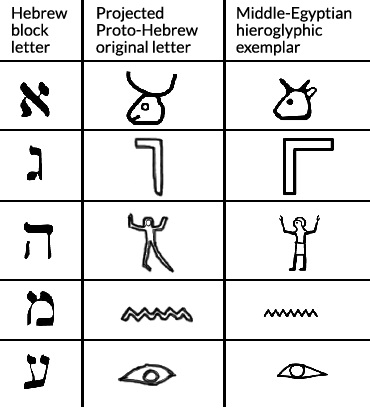
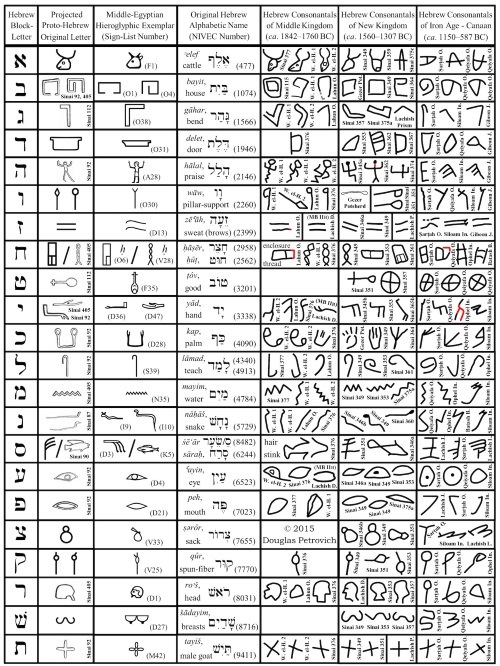
A comparison between the Hebrew block letters that came into use after the Babylonian captivity (that commenced about 586 BC), the proposed original alphabet of "Proto-Hebrew" and the Egyptian Hieroglyphs that may have been the basis for many of the letters. (from Douglas Petrovich)
The system for all these forms appeared to have been developed from Egyptian Hieroglyphics, which was used as a basis for creating 22 alphabetic letters representing consonantal sounds expressing the Semitic language of the writings. The first writings accepted by scholars as using "Hebrew" script are all from after 1000 BC and classified as using the "Paleo-Hebrew" alphabet.
The ironic thing is that these Paleo-Hebrew writings are often impossible to distinguish from the Phoenician ones and were just as much a natural development from the earliest Proto-Sinaitic and Proto-Canaanite examples. Yet most sources continue to communicate the standard paradigm. In their article on the Phoenician alphabet, Wikipedia states, "The Phoenician alphabet, called by convention the Proto-Canaanite alphabet for inscriptions older than around 1050 BC, is the oldest verified alphabet." This view is maintained despite the fact that the oldest examples don't come from Phoenicia and predate the existence of Phoenician culture. Might this practice be conveniently retained by those who don't want Moses to be considered as a possible author of the Torah?
Therefore, be very strong to keep and to do all that is written in the Book of the Law of Moses, turning aside from it neither to the right hand nor to the left. - Joshua 23:6 (ESV)
So did the Hebrew alphabet develop from Phoenician or was it the other way around? Could the earliest forms of the alphabet (Proto-Sinaitic and Proto-Canaanite) just as easily be considered as "Proto-Hebrew," and was it this early form of Hebrew that was the world's first true alphabet? This earliest form of Hebrew could have spread throughout the region and developed into what is now called Phoenician and Paleo-hebrew. The mainstream of scholarship has not gone in that direction, insisting that the most precise we can be with these alphabetic scripts is to say that they are Semitic, and Hebrew is only one variety of many Semitic languages from that time.
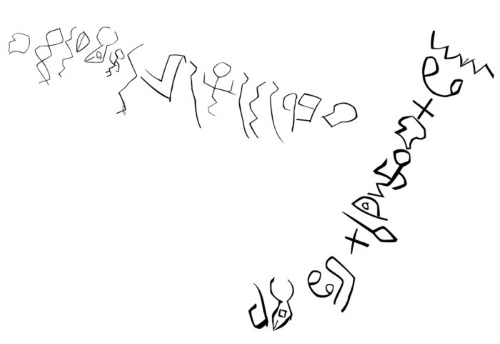
Things got more interesting when John and Deborah Darnell made a 1999 discovery in Middle Egypt of alphabetic inscriptions at a place called Wadi el-Hol. These appeared to be a hybrid between hieroglyphic symbols and alphabetic symbols that once again fit the scenario of hieroglyphs-to-Semitic-script scheme. The surprising thing was that they were dated to the 12th Dynasty, which in conventional terms equated to around 1850 BC.
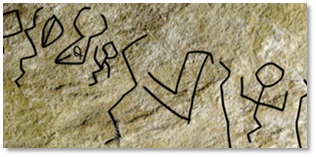
A line drawing of some of the world's oldest alphabetic inscriptions from Wadi el-Hol in Egypt's Middle Kingdom (18th Dynasty) around the time of Joseph. - BRUCE ZUCKERMAN IN COLLABORATION WITH LYNN SWARTZ DODD Pots and Alphabets: Refractions of Reflections on Typological Method (MAARAV, A Journal for the Study of the Northwest Semitic Languages and Literatures, Vol. 10, p. 89) (from wikimedia commons)
These realities prompted more scholars to return to the possibility that these early scripts were connected to the Israelites' stay in Egypt. Egyptologist David Rohl theorized that the initial breakthrough may have come from Joseph during his time in power in Egypt, and that this system was later developed by Moses in time for him to begin writing what would become the first books of the Bible at Mount Sinai. Rohl wrote the following:
"...it took the multilingual skills of an educated Hebrew prince of Egypt to turn these simple first scratchings into a functional script, capable of transmitting complex ideas and a flowing narrative. The Ten Commandments and the Laws of Moses were written in Proto-Sinaitic. The prophet of Yahweh - master of both the Egyptian and Mesopotamian epic literature - was not only the founding father of Judaism, Christianity and, through the Koranic traditions, Islam, but also the progenitor of the Hebrew, Canaanite, Phoenician, Greek and therefore modern western alphabetic scripts." David Rohl (2002), The Lost Testament, Page 221.
However, these assertions have not shifted the position of most scholars. There just wasn't enough specific evidence to move these early alphabetic writings from the category of "Semitic" to that of "Hebrew." Enter Douglas Petrovich and his claims of new and multiple examples of just such specific evidence. Exactly what he has found and what some of the initial reaction has been will be the subject of Part 2 of this article in next week's Thinker Update.
Part 2 (1-12-2017)
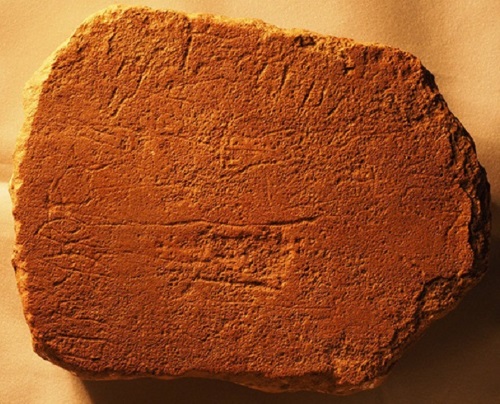
Sinai 361, part of a stone slab from Egypt, which Dr. Douglas Petrovich proposes contains the name Moses.
And Moses wrote down all the words of the LORD. - Exodus 24:4 (ESV)
In second of a three-part series, we will be looking at the controversial claims and startling new evidence from Dr. Douglas Petrovich that suggest the world's oldest alphabet was actually an early form of Hebrew.
I remember well the buzz around the halls and meeting places at the Evangelical Theological Society's meeting held in the fall of 2015 in Atlanta. Patterns of Evidence was there to promote their new film and book. The annual meeting featured hundreds of breakout sessions where leading Christian scholars from around the world presented their latest findings and proposals in their areas of specialization to several thousand attendees. With dozens of speakers to choose from during any given hour, deciding which session to attend was difficult. But the title of one presentation was the source of particular interest and excitement: "The World's Oldest Alphabet - Hebrew Texts of the 19th Century BC."
Groups I engaged with had already been talking about this presentation and as I negotiated the crowded hallways between presentations I overheard "I can't miss that one," from several hurried conversations. I knew I would need to get there early to secure a seat. It was the date in the title of the presentation that had captured the imaginations of so many. Hebrew texts that early in history were just so far beyond the normal scope of thinking (by about 1000 years) that they just had to see what was behind these fantastic claims.
Professor Douglas N. Petrovich.
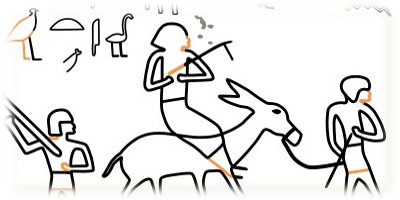
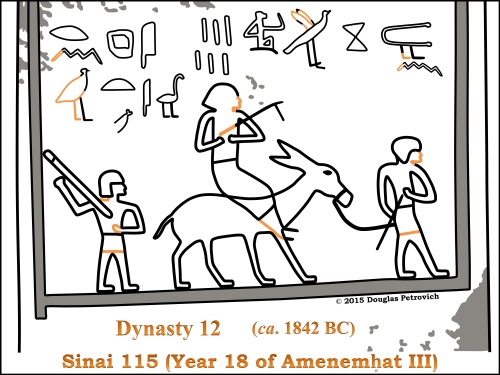
The presentation given to that overflowing room did not disappoint. Numerous examples of inscriptions were shown that not only pointed to Hebrew as the first alphabet, but also validated the biblical account of the Israelites in Egypt. Professor Petrovich had been studying the inscriptions on a series of 9-foot-tall stone slab markers called stele, which recorded the annual expeditions of a high official from Egypt down to the southwestern Sinai turquoise mines called Serabit el-Khadim. This is just west of the traditional Mount Sinai location. The official had recorded images of himself at the bottom of the stele where he was depicted on a donkey in the middle, with an Egyptian attendant walking behind him and a boy walking in front. Each year's inscription would show this boy growing taller. What caught his attention was that one stela did not use Egyptian hieroglyphics, but rather a rudimentary form of the alphabet in a Semitic language. If Petrovich's interpretation is correct it speaks of Joseph's son Manasseh and his son Shechem (Joshua 17:2).
The Manasseh inscription. (Credit: Douglas Petrovich)
The inscription included the date of Year 18 of Amenemhat III, the 12th Dynasty ruler around the time of Joseph in both the view of a Middle Bronze Age/Middle Kingdom Exodus around 1450 BC (represented in the film Patterns of Evidence: The Exodus by David Rohl and John Bimson) and in the view of a Late Bronze Age/New Kingdom Exodus at 1446 BC while retaining the conventional dating for Egypt (represented in the film Patterns of Evidence: The Exodus by Bryant Wood, Charles Aling and Clyde Billington and also held by Douglas Petrovich). This is because there are two main views for the length of the time the Israelites spent in Egypt - perhaps more on that debate in a future Thinker Update. Regardless, this date is more evidence that the Ramesses Exodus Theory held by the majority of scholars, may be causing them to miss evidence for the Exodus that actually exists centuries earlier than where they are looking.
If his interpretation is correct, it would also establish Hebrew as the world's first alphabet. According to Petrovich, the inscription says that this expedition included a group with significant connections to the early Israelites. He reads the inscription as, "Six Levantines, Hebrews of Bethel the beloved." The Levant is the area of Canaan and its surroundings. In the biblical account, Bethel was one of the headquarters of Jacob and his family before they moved to Egypt - it was their home town.
God said to Jacob, "Arise, go up to Bethel and dwell there. Make an altar there to the God who appeared to you when you fled from your brother Esau... And Jacob came to Luz (that is, Bethel), which is in the land of Canaan, he and all the people who were with him," - Genesis 35:1,6 (ESV)
Professor Petrovich said that the second of his forthcoming books will show clear proofs that the featured character can be none other than Manasseh the son of Joseph. This along with his other findings were again presented last November at the annual meeting of the American Schools of Oriental Research (ASOR), this time drawing the attention (and criticism) of a wider audience.
In Part 1 of the series it was shown that most academic outlets have long portrayed Phoenician as the world's first alphabet, which developed after the time of the Exodus and became the basis of all modern alphabets. This thinking has been propagated despite the fact that there has been clear evidence that the oldest examples of the alphabet don't come from Phoenicia and predate the existence of Phoenician culture. Leaders in the field would be careful not to ascribe the name of "Phoenician" to the first alphabet, but that message has not been getting out to the myriad of classroom and media outlets that continue to teach that.
This issue is critical for understanding the roots of the Bible, since the sophistication of the biblical narrative required an alphabet to be in place for it to be written. If the alphabet was first developed by Phoenicians in 1050 BC (or even around 1200 BC) that would mean Moses could not have been the author of writings that ended up becoming the first books of the Bible as tradition and the Bible itself claim. However, if the alphabet developed centuries earlier, in the very area where the Israelites are said to have been active in the years before and during the Exodus, then this would fit nicely with the claims of the Bible.
Many experts in the area of ancient languages have recognized that the earliest alphabetic scripts developed from Egyptian hieroglyphs and were in a Semitic language (the broad cultural group that the Israelites were a part of), but few have entertained the idea that this language may have been the more specific category of "Hebrew," the language of the Israelites.
As seen in an hour-long interview on Israel News Live, it started several years ago when Petrovich (an archaeologist and epigrapher at Wilfrid Laurier University in Waterloo, Canada) was studying Egyptian inscriptions and "accidentally" ran into the inscription mentioning Manasseh. According to Petrovich this led to finding "one gold mine after another" in additional inscriptions. "Never in my wildest dreams did I think I would bump into three significant biblical figures on three different inscriptions that all date to the middle of the 15th century or so BC," said Petrovich.
It was only after defining every one of the 22 disputed letters of this early alphabetic script and which Hebrew letter each early sign corresponded to that Petrovich was able to interpret the Semitic inscriptions. This led him to eventually propose that the Israelites were the ones who transformed Egyptian hieroglyphics into the world's first alphabet. These texts mainly originated in the locations of Serabit el-Khadim and Wadi el-Hol in Egypt.
Another inscription, this one catalogued as Sinai 376 from the 13th Dynasty, Petrovich interprets as saying, "The house of the vineyard of Asenath and its innermost room were engraved, they have come to life." This sentence has three words (house, innermost room, engraved) in common with 1 Kings chapter 8 where it talks about King Solomon's construction of the Temple in Jerusalem. Asenath was the wife of Joseph and certainly one of the most famous women in Egypt at the time.
...And he gave him in marriage Asenath, the daughter of Potiphera priest of On... - Genesis 41:45 (ESV)
And to Joseph in the land of Egypt were born Manasseh and Ephraim, whom Asenath, the daughter of Potiphera the priest of On, bore to him. - Genesis 46:20 (ESV)
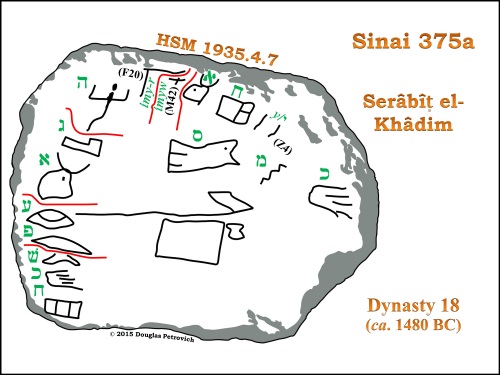
Two inscriptions from the time of the Exodus add fuel to the argument. In Sinai 375a (see below) Petrovich reads the name "Ahisamach" and his title, "overseer of minerals." Petrovich knows of no other instance of this name in any other Semitic language than Hebrew. In the Bible, Ahisamach was the father of Oholiab, who along with Bezalel was one of the chief craftsmen appointed for constructing the Tabernacle and its furnishings.
Sinai 375a with the etchings highlighted in black and the proposed Hebrew equivalents added in green containing the name "Ahisamach, overseer of minerals." (credit: Douglas Petrovich)
and with him was Oholiab the son of Ahisamach, of the tribe of Dan, an engraver and designer and embroiderer in blue and purple and scarlet yarns and fine twined linen. - Exodus 38:23 (ESV)
The second of the Exodus-era inscriptions is the most specific reference to the Exodus event. Naturally, it is also the most controversial of all. But that inscription, along with the debate that ensued, will have to wait for the final installment of our 3-part series on the world's oldest alphabet.
Part 3 (1-20-2017)
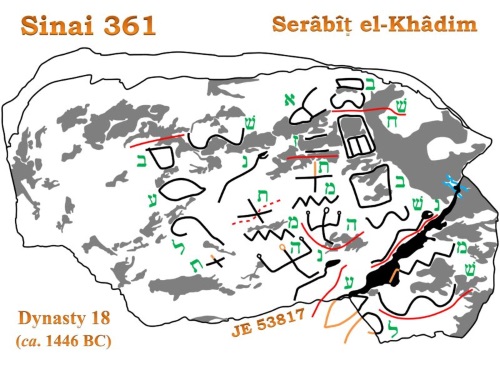
Sinai 361 (also photo below), with etchings highlighted in black and the proposed Hebrew equivalents added in green, which contain the name "Moses" in the lower right corner. (credit: Douglas Petrovich)
Then Pharaoh's servants said to him, "How long shall this man be a snare to us? Let the men go, that they may serve the LORD their God. Do you not yet understand that Egypt is ruined?" So Moses and Aaron were brought back to Pharaoh. And he said to them, "Go, serve the LORD your God... " - Exodus 10:7-8
In this third of a three-part series, we will look at perhaps the most profound and controversial interpretation proposed by Dr. Douglas Petrovich, and the debate that followed his announcements. As seen in Parts 1 and 2, Petrovich has proposed that there is now sufficient evidence to establish Hebrew as the world's oldest alphabet. If verified, this would push the first instance of Hebrew script nearly a thousand years earlier than previously thought, allowing the possibility that Moses actually was the author of the earliest writings in the Bible in the eyes of academia. This series of Egyptian inscriptions may also validate much of the history recorded in the Bible for the period of the Exodus.
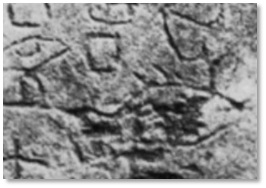
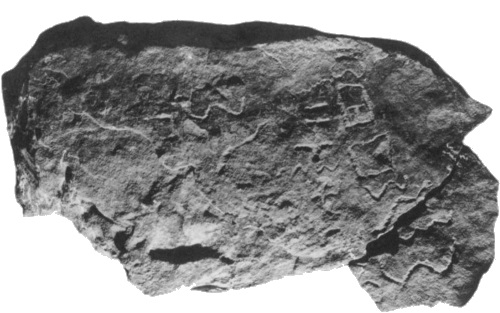
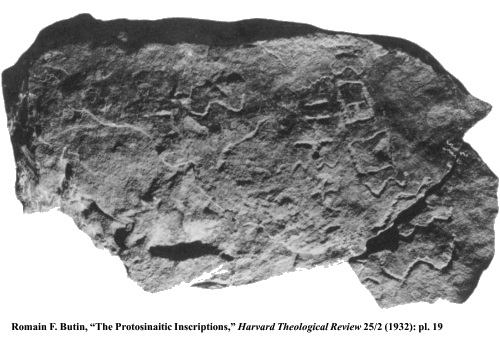
Of the controversial texts that originated from Serabit el-Khadim, the turquoise mines controlled by the Egyptians just west of the traditional Mount Sinai, one in particular raises the temperature of this debate. Sinai 361 (hand drawing above and photo below) may contain the name "Moses" and actually refer to the year in which the plagues and devastation were visited on Egypt. The inscription is laid out in vertical columns from right to left with Moses (actually, the Hebrew "Moshe") being mentioned at the bottom of the first column on the right. Petrovich reads this inscription as follows:
"Our bound servitude had lingered, Moses then provoked astonishment, it is the year of astonishment, because of the lady."
The "astonishment" could pertain to the Judgment step seen in the film Patterns of Evidence: The Exodus when Egypt was devastated. The present tense used in the inscription could mean that the message was even written as the plagues were in the process of playing out.
But I will harden Pharaoh's heart, and though I multiply my signs and wonders in the land of Egypt, Pharaoh will not listen to you. Then I will lay my hand on Egypt and bring my hosts, my people the children of Israel, out of the land of Egypt by great acts of judgment. - Exodus 7:3-4 (ESV)
The references to bondage, a year of astonishment, and that this was provoked by "Moses," all remarkably fit the Exodus account of the plagues and exodus out of slavery in Egypt as described in the Bible. Petrovich believes "the Lady" spoken of refers to the Egyptian goddess Hathor, who was often depicted as a horned cow. The Bible records the Israelites' tendency to revere the gods of Egypt as seen in the golden calf incident at Mount Sinai. A reference to this rebellion and what may be the year of astonishment occurs in Psalm 78.
How often they rebelled against him in the wilderness and grieved him in the desert!
They tested God again and again and provoked the Holy One of Israel.
They did not remember his power or the day when he redeemed them from the foe,
When he performed his signs in Egypt and his marvels in the fields of Zoan.
He turned their rivers to blood, so that they could not drink of their streams.
He sent among them swarms of flies, which devoured them, and frogs, which destroyed them.
He gave their crops to the destroying locust and the fruit of their labor to the locust.
He destroyed their vines with hail and their sycamores with frost.
He gave over their cattle to the hail and their flocks to thunderbolts.
He let loose on them his burning anger, wrath, indignation, and distress, a company of destroying angels.
He made a path for his anger; he did not spare them from death, but gave their lives over to the plague.
He struck down every firstborn in Egypt, the first fruits of their strength in the tents of Ham.
Then he led out his people like sheep and guided them in the wilderness like a flock. - Psalm 78:40-52 (ESV)
Photo of Sinai 361, part of a stone slab from Egypt, which Dr. Douglas Petrovich proposes contains the name Moses.
This inscription (along with the Sinai 375a inscription naming Ahisamach) includes no date, but Professor Petrovich assigns a date in the 18th Dynasty around 1446 BC, based on pottery remains from that period found in the caves. David Rohl, who favors the Exodus occurring at the end of the 13th Dynasty, counters that pottery can only be used to date items found in the same layer as the pottery when dealing with stratified remains in the ground. So a separate inscription on a rock wall or Stela found above ground cannot be linked to any pottery finds, especially at sites in an area known to have a long history like this one.
Petrovich replied that the principle to which Rohl was referring does not apply to a carved mine, but only to sites where architecture experienced various phases of construction/reconstruction with new floor levels that cleared out old material regularly. In contrast, Petrovich noted that that these mining shafts were only used by a band of males who visited this remote site no more than once per year for seasonal/annual mining activity. There would not have been maids, cleaning services, or renovating within the mine shafts. If the mines that yielded New Kingdom inscriptions had been used in earlier periods, there would be visible evidence of it preserved in these shafts. Yet none exists.
While Professor Petrovich admits that the datable pottery evidence is no guarantee of the first use of the mines, he believes there is enough evidence along various lines to ensure that these particular mines were not used during the Middle Kingdom. And so the debate goes on. Petrovich believes his reconstruction of the development of the earliest Hebrew script also strongly supports his view that these later inscriptions are from the New Kingdom. Once again, whether late 13th Dynasty or early 18th Dynasty, these inscriptions appear to pre-date a Ramesses Exodus by centuries.
In an article in Breaking Israel News Petrovich points to other "Bible-esque" statements that he has deciphered. A statement reading, "Wine is more abundant than the daylight, than the baker, than a freeman," was found in an inscription from late in the 12th Dynasty.
Another inscription (this one from Sinai 375a, and nearer the time of the Exodus) reads, "The one having been elevated is weary to forget." While Professor Petrovich has not asserted this link, I find the wording uncannily similar to the account of Joseph being raised to second in command after being cast out by his brothers. This action caused him to be enslaved in Egypt and then thrown into prison for several years before being elevated.
Then Pharaoh said to Joseph, "Since God has shown you all this, there is none so discerning and wise as you are You shall be over my house, and all my people shall order themselves as you command. Only as regards the throne will I be greater than you." And Pharaoh said to Joseph, "See, I have set you over all the land of Egypt." - Genesis 41:39-41 (ESV)
Joseph called the name of the firstborn Manasseh. "For," he said, "God has made me forget all my hardship and all my father's house." - Genesis 41:51 (ESV) [Manasseh sounds like the Hebrew phrase for making to forget]
Petrovich explains that other Semitic languages do not result in sensible renderings for these inscriptions, which is why they have never been interpreted before. And few have thought the Israelites were this early, so Hebrew was not considered an option. This earliest version of Hebrew could be thought of as "Hebrew 1.0," and according to Petrovich it alone works at translating the Egyptian inscriptions. "There were many 'A-ha!' moments along the way," he stated, "because I was stumbling across Biblical figures never attested before in the epigraphical record, or seeing connections that I had not understood before."
Petrovich continued, "My discoveries are so controversial because if correct, they will rewrite the history books and undermine much of the assumptions and misconceptions about the ancient Hebrew people and the Bible that have become commonly accepted in the scholarly world and taught as factual in the world's leading universities."
As expected, criticism swiftly followed Petrovich's presentation at ASOR. The primary critique thus far has come from Dr. Christopher Rollston of George Washington University, one of the leading American scholars in the field of epigraphy and ancient inscriptions from the area of the Levant. On December 10, 2016, he wrote an article on his website titled: The Proto-Sinaitic Inscriptions 2.0: Canaanite Language and Canaanite Script, Not Hebrew. In it he stated the following:
"As for the script of these inscriptions from Serabit el-Khadem and Wadi el-Hol, the best terms are "Early Alphabetic," or "Canaanite." Some prefer the term "Proto-Sinaitic Script." Any of these terms is acceptable. But it is absolutely and empirically wrong to suggest that the script of the inscriptions from Serabit el-Khadem and Wadi el-Hol is the Hebrew script, or the Phoenician script, or the Aramaic script, or the Moabite script, or the Ammonite script, or the Edomite script. The script of these inscriptions ... is not one of the distinctive national scripts (such as Phoenician or Hebrew or Aramaic, etc.), but rather it is the early ancestor of all of these scripts and we term that early ancestor: Early Alphabetic."
Professor Rollston is arguing that these inscriptions can't be called Hebrew because they are clearly "Early Alphabetic" or "Canaanite" (what many call Proto-Canaanite or Proto-Sinaitic), and Canaanite can't be said to be in any particular language, therefore it can't be Hebrew. But Petrovich is arguing against the very premise and the conventional thinking that the Early Alphabetic script can't be thought of as being in one particular national language. Obviously, some group of Semites who spoke some particular language developed it - and why not the Hebrews? The developers of the Early Alphabetic script had to be either the Hebrews or the Phoenicians or the Arameans or the Moabites or the Ammonites or the Edomites or the Midianites etc. One of them had to have been the first. And it just so happens that the Hebrews were in Egypt at just the time that this Semitic script developed from hieroglyphs into alphabetic symbols, and these earliest inscriptions just happen to feature the unique names of characters from the biblical story of the Israelites in Egypt and later during the Exodus.
It is true that there is a script called "Hebrew" (or Paleo-Hebrew) that can be seen in inscriptions from around 1000 or 900 BC, and this "Hebrew" script is different than the earliest alphabetic script. But no one is disputing that point. The question is whether there is a precursor to that script - an earlier form of Hebrew (what Petrovich likes to call "Proto-consonantal Hebrew") - which was the world's first alphabet and has been called Early Alphabetic (or Proto-Canaanite) up until now. This script would then have developed into various branches used by the different groups in the region, including a gradual development into later forms of Hebrew like the one called Paleo-Hebrew today. The new book by Petrovich discusses this process extensively. He points to evidence showing that the Hebrew letters continuously evolved, becoming less pictographic over time, until eventually being converted into block letters.
The development of Proto-consonantal Hebrew as proposed by Douglas Petrovich
Rollston focuses the majority of his critique on Petrovich's interpretation of some words as "Hebrew" when they, in fact, appear in other Semitic languages and can have several possible meanings. But a large part of Petrovich's argument relies on the context of these inscriptions using uniquely biblical names in the correct time periods when those figures were active. Additionally his case rests on the claim that some of these inscriptions can only make sense when the Hebrew terms are supplied rather than the other options. To assess the strength of that argument, scholars will need to read the full proposal set out in Petrovich's new book, something no one has been able to do yet. Petrovich will lay out his findings in full in the first of his forthcoming volumes; The World's Oldest Alphabet available now for preorder through Carta out of Jerusalem.
In an exchange on Facebook, David Rohl said it was valid for Rallston to classify these early writings as Semitic. But Rohl pointed out that Rollston's reasons for not considering "Hebrew" as the type of Semitic involved, were dependant on his view that Israelites only existed in the centuries immediately preceding Ramesses II, and not as early as these inscriptions. If Rohl's (or Petrovich's) view was correct, the Israelites were around in the 12th Dynasty and Hebrew should be considered as a legitimate candidate for these earliest alphabetic inscriptions. Rollston responded, "Oh, David, you are so utterly mistaken about so much. It will serve no purpose for me to try to point such things out to you again...it would serve no useful purpose. So sorry. My analysis is based on actual inscriptions, diagnostic elements of language and script. Bless your heart. Be well and prosper. Sincerely, Chris"
The lack of willingness to engage in this important aspect of the debate caused Rohl to throw up his hands and say there is no way to force scholars to question their long-held traditions - academic inertia is hard to overcome. We look forward to continuing the debate in our upcoming Patterns of Evidence film series, hopefully with Douglas Petrovich and Christopher Rollston participating.
Professor Petrovich summed up, "Truth is un-killable, so if I am correct, my findings will outlast scholarly scrutiny. I have no doubt whatsoever that Hebrew is the world's oldest alphabet."